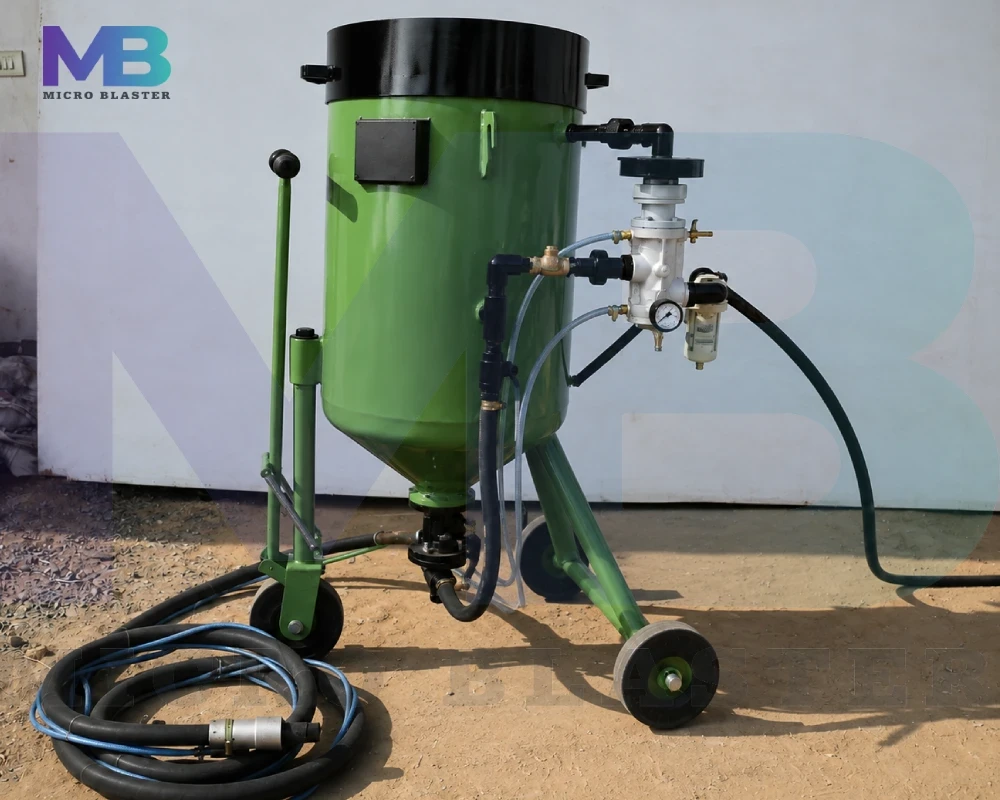
Dry, Wet, Suction Blasting
Grit Blasting
Enquire now
Datasheet
Where it is used
Typical process uses for Grit Blasting Nozzle across industrial surface preparation.
Dry, Wet, Suction Blasting
Scrubber
Descaling
Spray Drying
Abrasive Waterjet and Slurry Jet
What to know
A Grit blasting Nozzle life is very hard for one to predict accurately because of the many features such as the vast range of abrasive media being used, their sizes, their different shape, their hardness, varying air pressure coming at the nozzle for grit blasting, The Grit blasting nozzle tips bore size and blasting nozzle mouth diameter during blast hose life, methods of abrasive media cut-off or machine shut-down. Grit-blasting Nozzle size is of varying shapes used to blast different patterns on the blasting surface.
When selecting a nozzle for a grit blasting machine, there should be a balance to be kept in mind, and it starts with our air compressor (sandblast nozzle air consumption). Once we understand how the size of our compressor for grit blast nozzle air consumption affects production capabilities, then we will look at tungsten carbide nozzle size.
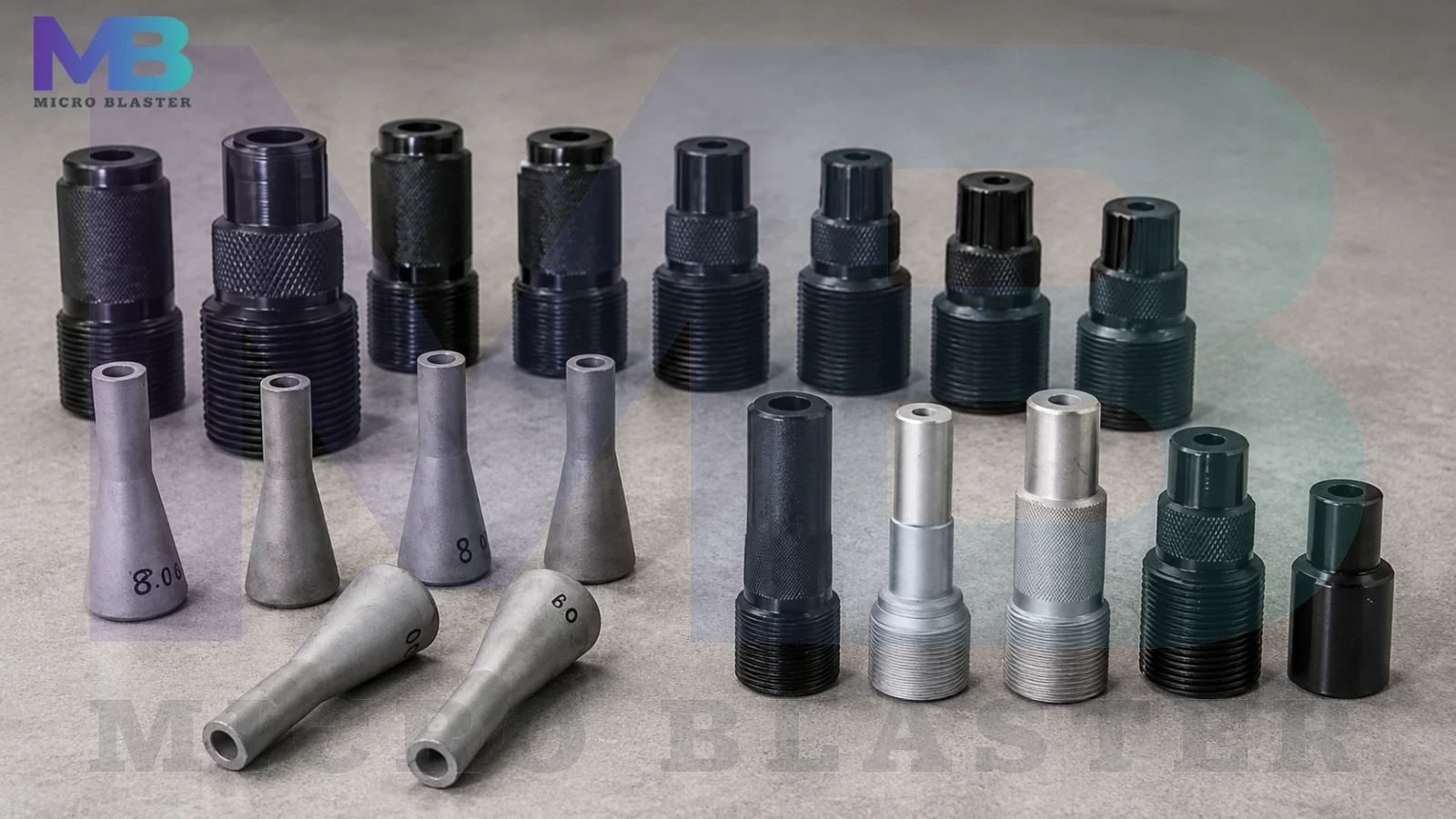
The Next consideration is the grit-blasting nozzle size & shape. Grit blasting nozzle types are mainly two shapes straight bore and venturi nozzle, venturi grit blast nozzle is of multiple sizes and with various different patterns. Lastly, we want to consider the material from which the nozzle is made of. The three main factors in selecting the ideal air blast nozzle for grit blasting bore material are durability, impact resistance, and price.
The more air volume compressed per minute, the higher is the pressure produced at the air blast nozzle. This improvises the production rate in two ways:
For grit abrasive blasting, the most commonly-used air blast nozzle orifice sizes range from 3/8″ inner diameter to 3/4″, increasing by increments of 1/16″. An 8mm air blast nozzle is constructed to generate pressure at 120 CFM air compressor. A 10 mm grit-blasting nozzle is enough to generate an effective blasting pressure at 210 CFM air compressor.
It’s important to notice that when we double the diameter of the orifice, we quadruple the size of the orifice and the volume of air and abrasive media that can pass through the grit blasting nozzle.
To find our optimally productive grit blasting nozzle, determine what nozzle pressure (PSI) we need to maintain for productive blasting, and grit blast nozzle air consumption or what volume of air our available air compressor can supply per minute (CFM).
Grit blasting Nozzles are of two basic shapes: straight bore and Venturi, with several different variations of venturi grit blast nozzle.
As compressed air enters the converging (left) end of a straight bore nozzle it accelerates, accelerating the abrasive media particles suspended in the flow. These abrasive media bits exit the nozzle in a stable stream and produce a narrow, concentrated blasting pattern upon impact surface.
Blast Pattern: 3″ at 18″ distance
Production Rate: 4.5/5
Venturi nozzles have a converging entry and a diverging exit. This shape is designed to produce an effect that greatly accelerates the airflow and media particles.
The Venturi effect is an observation that when an airflow accelerates while passing through construction, there is a corresponding drop in pressure level.
Besides producing tremendous acceleration, the angled shape nozzle of the diverging end spreads out the flow, producing a large blast pattern and a more uniform particle distribution than a standard bore nozzle.
Long Venturi nozzles give up to 40% better production rates and consume less abrasive material compared to straight bore nozzles.
Blast Pattern: 3″ at 18″ distance
Production Rate: 4/5
A double Venturi nozzle is with an extra-wide exit opening and holes at the diverging end.
According to the Venturi effect, as the velocity of the flow increases, the pressure drops, creating a vacuum between the shockwave and the throat, reducing abrasive material velocity. With a double Venturi type nozzle, atmospheric air is inserted through the holes into the low-pressure area, expanding the airflow to produce a huge blast pattern on the blast surface.
Blast Pattern: 3″ @ 18″ dist.
The Rate of Production: 5/5
Broad throat nozzles are a wide throat and an extra-1/4″ wide converging region. When used in coincidence with a hose pipe with matching inside diameter (and with a corresponding air volume increase), the wide throat nozzle can improve productivity level up to 15% over a long Venturi nozzle.
Blast Pattern: 5″ at 48″ distance
The Production Rate: 3/5
These are extra-long nozzles accelerating media particles over a longer distance, achieving higher exit velocities, allowing the blaster to stand further back from the surface being blasted, and producing a larger blast pattern and higher production rates.
The third consideration while choosing a nozzle is the material of the lining inside the bore. More obstinate materials will be more resistant to wear, but are extra expensive to replace and are prone to cracking under rough handling. There is two basic types of nozzles and their details.
Durability: 1/5
Impact Resistance: 5/5
Price: Low
This tungsten carbide nozzle is the least durable of the carbide nozzles, but relatively less costly and resistant to impact. Chiefly fit for blasting with copper slag, glass, and mineral abrasive media.
Durability: 3/5
Impact Resistance: 1/5
Price: High
Boron carbide nozzle is extremely hard and durable, but brittle in nature. It can give up to ten times the longevity of tungsten carbide.
Enquiry form
Fields marked with * are required.
FAQ
Quick clarity on quotation, supply and what our team needs to size Grit Blasting Nozzle correctly.
Grit Blasting Nozzle is a blast abrasive used in surface preparation and peening processes. It is selected by size, hardness and shape to match the base material, required surface profile and whether the application needs cleaning, profiling or shot peening.
Grit Blasting Nozzle is used in grit blasting and shot blasting operations across fabrication, foundry, automotive, pipeline, shipyard and general engineering. Typical jobs include rust and scale removal, weld cleaning, anchor profile before coating, and peening of stressed components.
Share your application, required grade or size, monthly or project quantity, packing preference and delivery city or port. Micro Blaster quotes manufacturer-direct with clear scope for packing, freight and documentation — not a generic list price.
Grit Blasting Nozzle is supplied in standard bags or drums suited to bulk industrial use, with batch-wise size consistency. Domestic and export orders are supported; mention your preferred packing and destination when requesting a quotation.
Most enquiries for blast media receive a technical and commercial reply within one business day during working hours. Include quantity, application and delivery location for the fastest response.